
Local Farmers on the Cost of Running a Sustainable Business
Sheree Bishop, Communications Coordinator
May 22, 2026
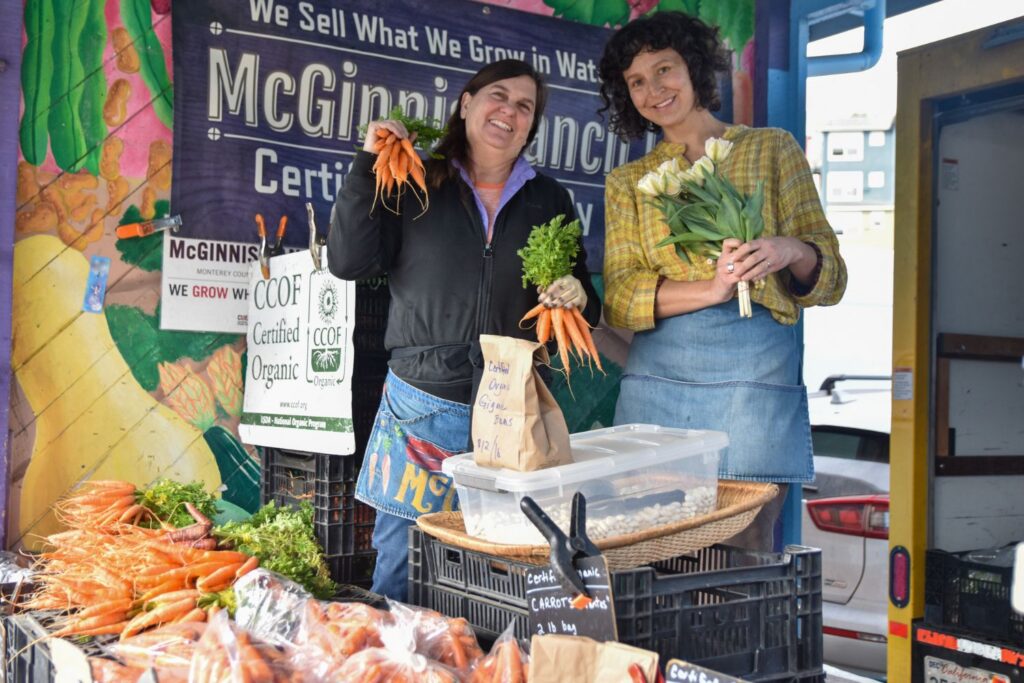
Have you ever wondered why food at the farmers market is priced the way it is? With the costs of labor, hand harvesting, gas mileage, utilities, and more, paying the bills while keeping prices accessible for shoppers is a delicate balancing act for farmers. As the cost of living increases, affordability is top of mind for everyone, and farmers are no exception.
We spoke to a few of our farmers about the money they invest into growing fresh produce, and all of the care and consideration that goes into the prices you see at the market.
McGinnis Ranch: The Cost of Seeds, Irrigation, and Labor for Growing Organic Carrots and Flowers
For certified organic farms like McGinnis Ranch, sourcing organic seeds can be costly. Some of these seeds, such as those Sandi McGinnis Garcia purchases, have a lower-than-average germination rate. Though this rate is largely determined by genetics, seed quality, and storage, conventional seeds are sometimes treated with fungicides that certified organic farmers don’t use. These fungicides can affect germination.
In turn, Sandi says that most seeds have a 92-95% germination rate, compared to around 80% for the organic seeds she uses. An 80% germination rate means that 20% of the seeds they plant will never sprout.
Irrigation costs are also rising for local farmers. The electricity metered from pumping the well alone is $1,000 per month, not including the water bill. “We pay per acre-foot of water, and they just raised the costs of their management fees. We have a meter on our wells, and then they charge according to that. So that cost has gone up, along with fuel costs and labor costs,” Sandi says.
In 2019, the California Labor Commissioner’s Office made changes to the standard work week and overtime hours for agricultural employers and workers. In the years since then, the workweek has gone from 55 hours of regular pay with 9.5 hours of overtime (paid at 1.5x the regular pay rate) to 40 hours of regular pay with 8 hours of overtime.
Sandi finds it important to balance following new laws with making sure her team of farmers is paid a fair wage. “We don’t want to take hours away from them. What they want is to work 54 hours. And so, in order to give them 54 hours, we pay for 14 of those hours at time-and-a-half.”
As a result, Sandi also focuses on making things more efficient in order to avoid raising prices for shoppers at the farmers market. “We’ve started using less packaging and cut [costs] in other ways that we found were beneficial for both the environment and for the business,” Sandi says.
As Sandi sees it, the cost of food from local family farms is worth it to keep industrial agriculture from overtaking the food system.
“It is more expensive, but it’s not just for your health, it’s for the environment,” Sandi says. “You’re sustaining a farm. And if you don’t buy things from small family farms, there won’t be any more of them. If there weren’t any, what then? What would your choices be?”
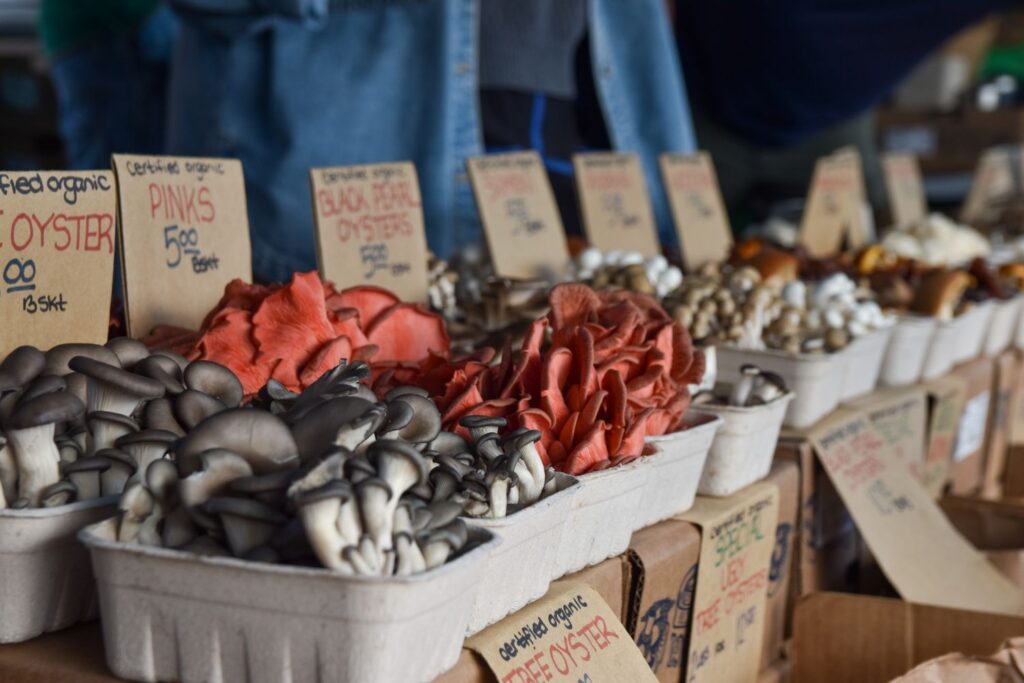
Far West Fungi: The Cost of Growing Truly Local, Organic Mushrooms and Sustainable Packaging
Along with tinctures and other products, Far West Fungi offers certified organic mushrooms at $10 per bag and $5 per basket. Kyle Garrone of Far West Fungi says that one of their highest costs is paying the people involved in the energy- and labor-intensive growing process.
To grow their wood-based mushrooms, they get raw sawdust from a local company. That wood is aged for three months and combined with a variety of supplements, including rice bran purchased from a vendor in Sacramento.
The mixture of wood, rice bran, and other supplements is then bagged. It has to be placed in special filter patch bags designed for growing mushrooms. They’re sterilized in an autoclave, which operates like a pressure cooker to remove contaminants. Mycelium is introduced to the substrate in a lab. After that, it goes into an incubation room and then into a harvest room. where it has to be harvested by hand once it’s fully grown.
Far West Fungi uses only cardboard packaging for mushrooms. In recent years, even the price of that packaging has gone up.
“I think we’ve seen almost a 75% increase, just the cardboard itself,” Kyle says, “from our boxes, to the raw material that we grow the mushrooms on, I think everything has seen an increase over the years.”
Far West Fungi’s response to rising costs is to increase efficiency rather than raise prices for shoppers. “Around the pandemic, we increased our prices, and we hadn’t increased anything for about 10 years before that. What we’ve focused on is trying to make ourselves more efficient,” Kyle says.
He continues, “We’ve increased our yields and our production, and that’s allowed us to actually keep our prices pretty stable. We’re very price-conscious. We try to make sure that we have competitive pricing and that we’re not overpricing the products that we produce.”
Grocery store mushrooms aren’t always what they seem. Many industrially grown mushrooms labeled “Made in the USA” are actually grown using an imported substrate, whereas Far West Fungi sources their substrate and grows their mushrooms in California.
“When you go to a farmers market, I think you have a much better understanding of what you’re consuming. As we expand and the food systems change, I think it’s a great way of supporting local agriculture and understanding how these systems work,” Kyle says.
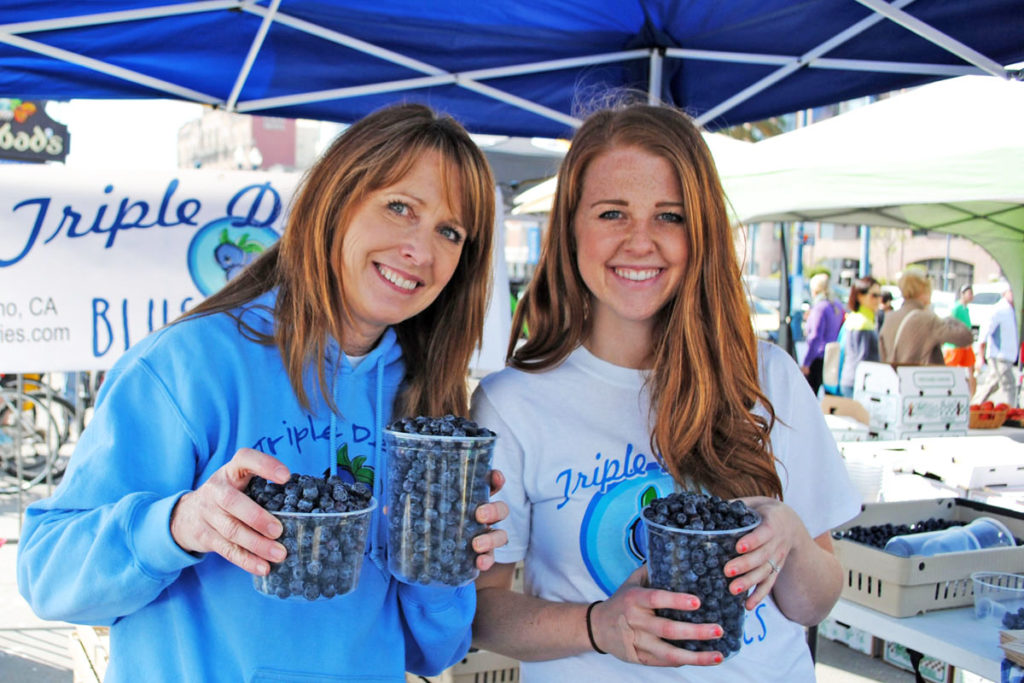
Triple Delight Blueberries: The Cost of Handpicking and Sorting Organic Blueberries
At Triple Delight Blueberries, customers can pick up Star and Snowchaser blueberries, in pint and quart containers priced at $11 and $19, respectively. While these prices are higher than they would be at a grocery store, there are important differences in how their berries are harvested and brought to market that affect their quality and how they taste.
“I think farmers market customers in general are so appreciative of what we do. We put a lot of extra costs into our farming practices, because we want our taste and our quality to be really superb,” says farmer Kim Sorensen.
After berries are handpicked by their team, the fruit is sorted at a packing house before it’s brought to the market. “We spend the money to have everything sorted so that anything that’s maybe soft or not quite ripe is going to get sorted out. We’re not going to bring that. We’re only bringing the very best,” Kim explains. All of this care and attention translates to higher labor costs.
Triple Delight also reimburses for mileage, which includes factoring in high gas prices to help their team transport berries in refrigerated trailers. “I think a lot of farmers don’t ever get to see the people who eat their fruit or eat their produce. And we do. It’s a blessing, and we’re thankful for that,” Kim says.