
5 Reasons Why Farmers Market Strawberries Taste Better
Sheree Bishop, Communications Coordinator
May 8, 2026

You might assume that the strawberries you buy at the grocery store are identical to those at the farmers market. When growing practices, distance traveled, and flavor are taken into account, the differences between locally grown strawberries and their conventionally grown counterparts become clear. Just bite into a farmers market berry, and you can taste the difference.
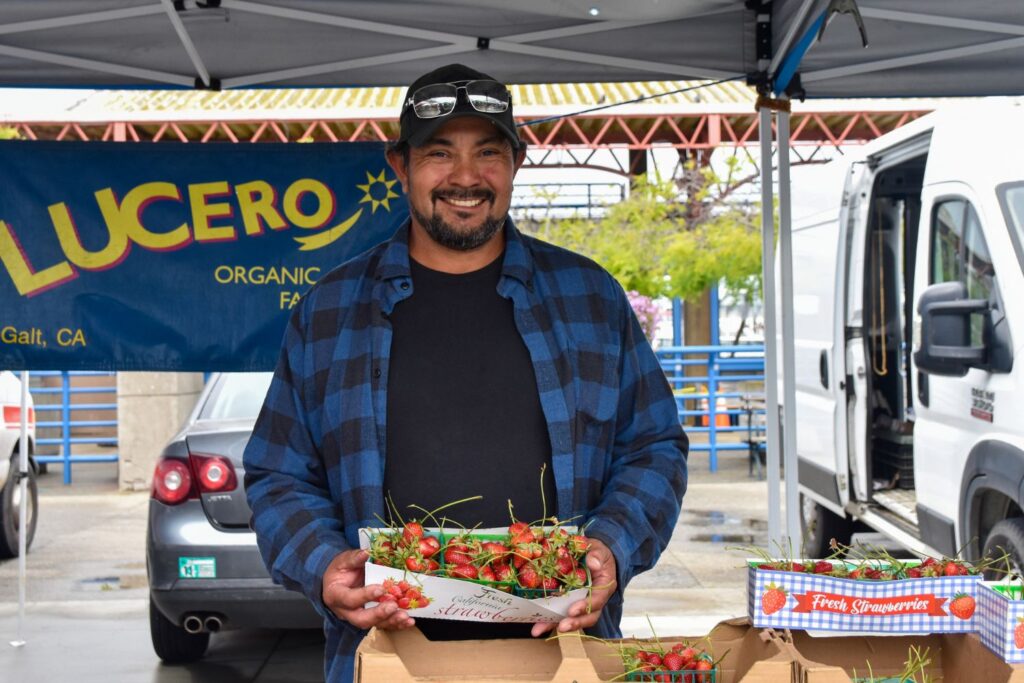
We spoke to Curtis Lucero of Lucero Organic Farms and Poli Yerena of Yerena Farms about their strawberries, shoppers’ most frequently asked questions, and the best ways to eat and store their delicious fruits.
Some Farmers Market Strawberry Varieties Won’t be Found at the Grocery Store
Most of the strawberries you find in the grocery store fall into a few common high-yield varieties, like Albion or Chandler. Poli says that many people don’t realize that strawberry varieties differ. For example, Seascape berries are sought after for their unique flavor as well as their small size. “Most of the recipes call for that particular variety because it’s kind of sweet and sour. And when you add the sugar, the flavor comes out,” he says.
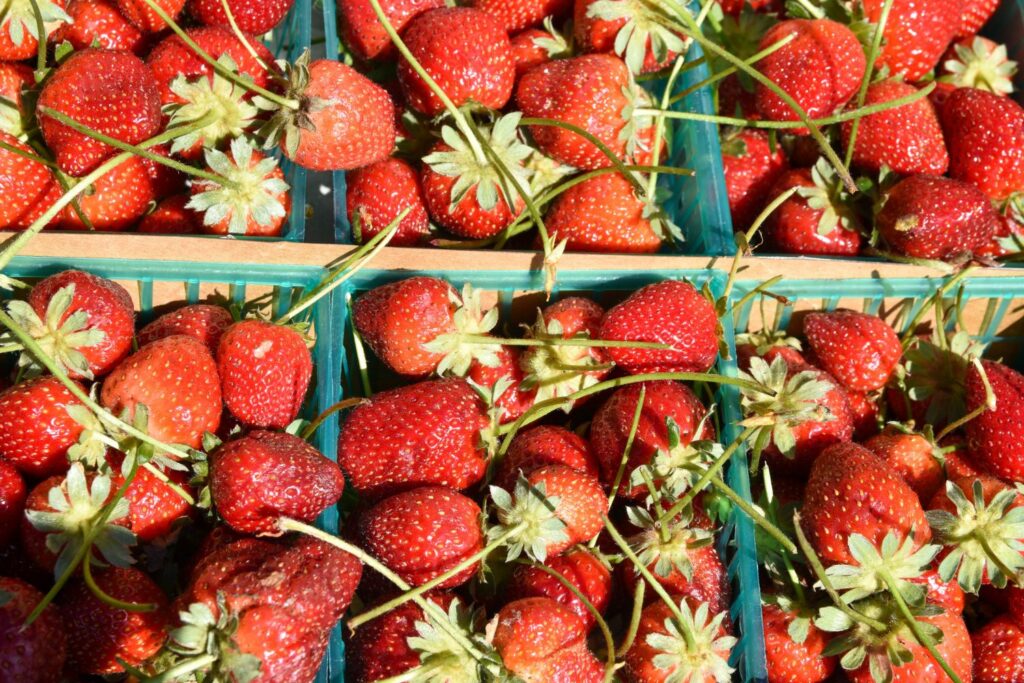
Yerena Farms also offers the Mara de Bois strawberry, which can be spotted by its black seeds. These especially delicate berries can’t survive transport and time sitting on grocery store shelves, which means many miss out on their particularly sweet flavor.
When you stop by Lucero Organic Farms on a Saturday, you may notice long stems on the strawberries. These stems are left there on purpose to resemble wild strawberries. “My father started doing that decades ago. People would compare them to the Fraises des Bois in France. He wanted to stand out from all the other berry growers,” Curtis shares.
Organic Strawberry Production Is Increasing More Than Non-Organic Production
Each year, the Environmental Working Group’s Dirty Dozen analyzes USDA data to identify the 12 conventionally grown fruits and vegetables with the highest pesticide residues. Strawberries consistently make the list. In their words, “when it comes to pesticide residues, non-organic strawberries are still the worst offender.”
In comparison, certified organic farms, such as Lucero Organic Farms and Yerena Farms, use organic methods such as beneficial insects to keep pests away, which allows them to grow flavorful fruit without pesticides.
Organic strawberry production has been increasing at a faster pace than conventional, non-organic production. According to the USDA, in California, which grows more than 75 percent of the domestic organic production, organic strawberry acreage tripled from 2008 to 2019.
Poli Yerena chose to farm organically in response to his experience working on conventional farms. “Back in the ’70s, we never thought of growing strawberries without chemicals,” Poli says, “But once we knew the balance between the good and the bad insects, we understood the whole concept of organic.”
Farmers Market Berries Have a Sweeter, Peak-Season Flavor
When you purchase conventionally grown strawberries at the store, you are usually purchasing strawberries that were picked several days ago. Those berries are often picked for long-distance travel and storage, rather than peak ripeness and flavor.
“They put them in the cooler, and they wait for one or two days until a semi truck comes and picks them up. And then the semi truck takes them to their warehouse. And they stay there for another couple of days. And then they transport them to different locations. So, by the time people are getting those berries, they’re about a week old,” Poli says.
On the other hand, farmers market berries are often picked the afternoon before they go to the market. If you’re shopping for berries at a market in the evening, like the Mission Community Market, then there’s a chance that the berries were picked that morning.
Not only are the berries fresher, but they’re often a bit more ripe as well. “Fortunately for you, my workers and I pick all the berries nice and ripe, ready to eat that day,” Curtis says. You can’t get farmers market strawberries year-round. That’s a large part of what makes them taste better. Most of the wintertime strawberries sold in the US are either grown in Florida or imported from Mexico. In addition to not having the best possible flavor, berries imported from Mexico are often picked by workers paid lower wages than those on local farms.
Strawberries Can Differ Slightly in Flavor Based on Where They Grow
Weather and climate affect which varieties can grow, and can produce slight differences in the flavor. Poli, whose farm is in Santa Cruz County, notes that strawberries grown closer to the coast have a sweeter flavor.
“The ones that are grown inland, they mature in a day. So the ones that are grown close to the ocean, they mature in four days,” Poli says. “The ones close to the ocean, they develop more sugar than the ones that are growing inland. So, for instance, you go and pick some strawberries today. You have to go back in three days, four days. Pick them again.”
When Ben Lucero, Curtis’s father, first started at the Ferry Plaza Farmers Market, the farm was located in San Martin, which is slightly cooler than where they are now. They moved to Lodi in 1999, but the San Joaquin Valley was too hot to grow the varieties that he wanted.
“The berries would just fall apart and dry out,” Curtis says, “So, he did some research. He looked it up and found out that UC Davis had bred an ever-bearing strawberry called Seascape.”
Now, at their farm in Yolo County, Curtis and Priscilla Lucero grow an abundance of Seascape strawberries. “As the weather gets warmer, it gets sweeter a lot faster than most berries,” he says.
You Can Enjoy the Same Berries That Chefs Use
Farmers market strawberries are well-loved by pro chefs and home cooks alike. Chefs often purchase flats of Seascape strawberries because their small size allows large quantities, around 35 to 40 berries, to fit into a flat. Chef Naseer Amar of Parachute Bakery purchases flats of berries from Lucero Organic Farms for a delicious and beautiful topping that he and his team don’t have to slice or spend a lot of time prepping.
“Chef Naseer, he comes over here, he’s like, ‘Hey, I need five flats’,” Curtis says. “A lot of chefs use them for different reasons. Usually, garnish toppings. They say ours taste a lot sweeter, and they’re more concentrated in flavor just the way we grow them.”
Even if you’re not making professional desserts, you can still enjoy farmer market berries as a snack, in a salad, or juiced as a fresh agua fresca, which is Poli’s preferred way to enjoy the harvest.
Strawberry tastings at Foodwise’s Seasonal Spotlight booth give shoppers a chance to try farmers market berries incorporated into a recipe before they buy them. “When they do the strawberry tasting up front, that’s the day I usually sell out super early,” Curtis shares.
When you take your berries home, Curtis says they’re best stored unwashed, wrapped in paper towels, and placed in an airtight container.
The next time you’re searching for a perfect basket of strawberries, look for a shine and a rich, red color. Curtis encourages farmers market shoppers to let their eyes be their guide.“You want it to be dark red, and usually there’s always a basket or a three-pack that catches your eye, that sparkles at you. Shoppers look around, and they’re like, ’This one right here,’ And I go, ‘That’s a perfect choice.”
Find Lucero Organic Farms at the Ferry Plaza Farmers Market on Saturdays, and Yerena Farmers at the Ferry Plaza on Saturdays and Tuesdays, Alemany on Saturdays, and Mission on Thursdays.
Topics: Farmers market, Farms, Fruit