
How Your Support Changes the Game for BIPOC Entrepreneurs Like Chef Sarah Germany
December 26, 2025
Despite making up 13% of the population, in 2024, Black-owned businesses were only approved for 7% of the loans offered by the US Small Business Administration. Because of the barriers created by systemic racism, BIPOC entrepreneurs have a harder time accessing the resources they need to develop, sell, and market their products.
That’s why Foodwise provides market opportunities, financial support, and technical assistance for BIPOC entrepreneurs at our farmers markets through our Building Equity program. When you support Foodwise, you are helping early-stage BIPOC food entrepreneurs market-test and build a customer base, so they are set up for success as they grow their businesses.
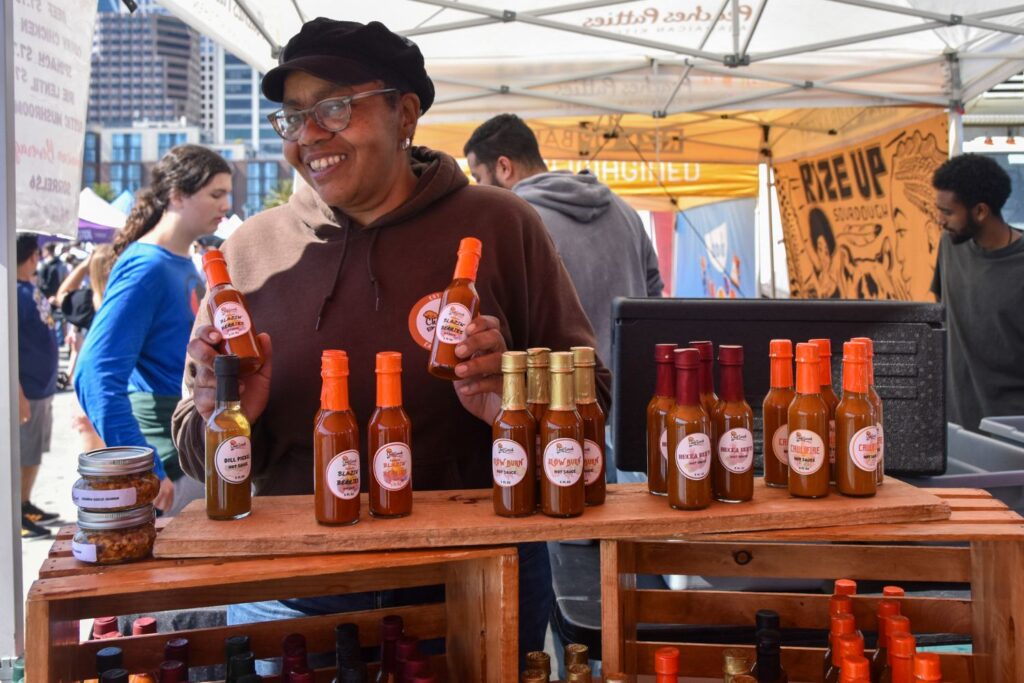
Chef Sarah Germany joined the Building Equity program in 2023 through Mandela Partners, one of our Building Equity community partners. Her business fights food waste by using cosmetically challenged and exces produce to create hot sauces, pickles, and more. Each of her recipes is carefully crafted to offer a variety of anti-inflammatory and digestive benefits.
In the span of a year, Chef Sarah Germany went from being a temporary booth at Foodwise’s Pop-Ups on the Plaza events, to having a weekly pop-up residency through Mandela Partners, to being a permanent Ferry Plaza Farmers Market vendor in April 2024. Now, with a loyal customer base of market regulars, Chef Sarah has expanded her repertoire of hot sauces, hired staff, and been able to sell her products in San Francisco retail stores.
Chef Sarah shares more about how her business got started, her journey joining the Building Equity program and the farmers market, and how your support of Foodwise helps small businesses like hers thrive.
Turning Surplus Produce into a Successful Hot Sauce Business
Before I started my business, I managed a cafe in East Oakland. The cafe was connected to a farm located on a high school campus. When COVID came, and everything closed, no one was buying produce from the farm. No one was at the schools to accept the produce, and there was a crazy excess of food in East Oakland all of a sudden.
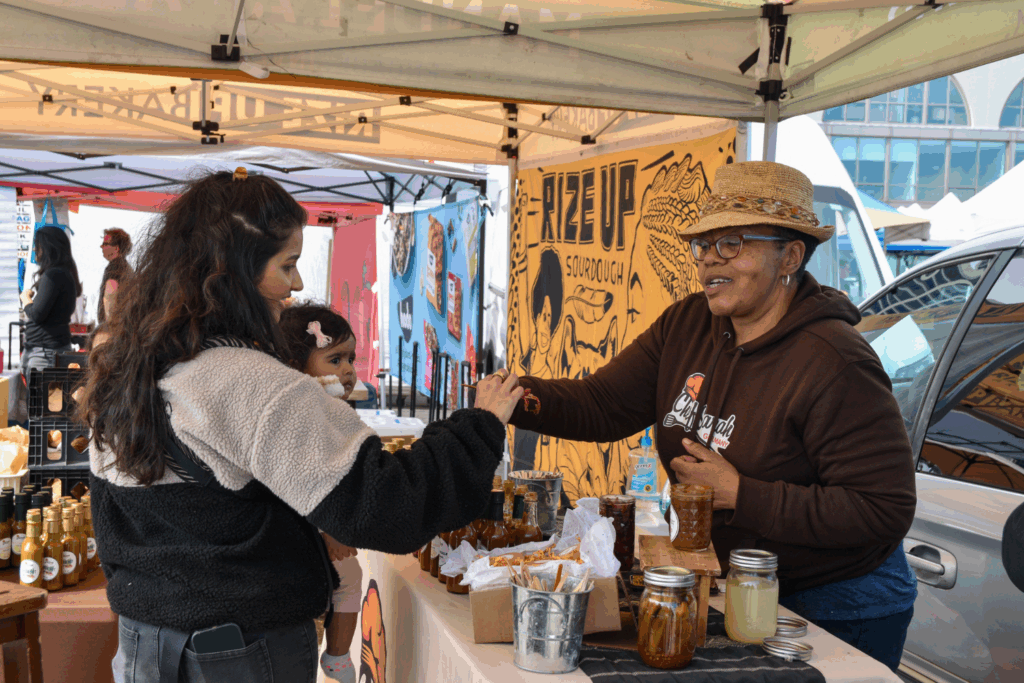
I worked with farmers to figure out how we could preserve this food. It became really exciting to figure out, particularly cross-culturally, how people were using different plants to create these medicinal tonics. That’s how our hot sauces started, as more of a fire cider kind of thing. The initial three hot sauces that we created were a Watermelon Hot Sauce, which was a digestive aid, a Lemon Ginger Blaze, which was a tonic for your sinuses, and then a Tropical Thunder, which was an anti-inflammatory hot sauce. We were also making catfish chowder.
I found out that Mandela Partners offered an entrepreneurial training program, which I’d joined because I realized that we were selling stuff, but I had no idea how to be in business. After I finished the Mandela Partners Food Business Pathways Program, we got invited to Pop-Ups on the Plaza: Celebrating Black Women Makers in March of 2023. That’s how I got connected with Foodwise, then became a weekly pop-up at the farmers market that summer.
We get to the Ferry Plaza and, while people are loving our catfish chowder, it’s the hot sauce that they’re going crazy about. They’re coming back every week asking, “Can you make a hotter one?” We’re meeting all these new farmers, like Tierra Vegetables, and being introduced to peppers like Urfa peppers. One of the customers came one day, gave us some Carolina Reapers, and was like, “Here, put this in the hot sauce.” People just started gifting me chiles. The next thing you know, we’ve got a dozen varieties of hot sauces.
Being in the Building Equity program gave us the opportunity to market test, to figure out what would sell and what customers wanted. Then, in that, we took our food waste reduction model and maximized what we could do with it and still meet this heat craze. I feel blessed that I can take these skills and talents to create that, and put a dent in this excessive waste situation.
Finding a Supportive Community at the Farmers Market
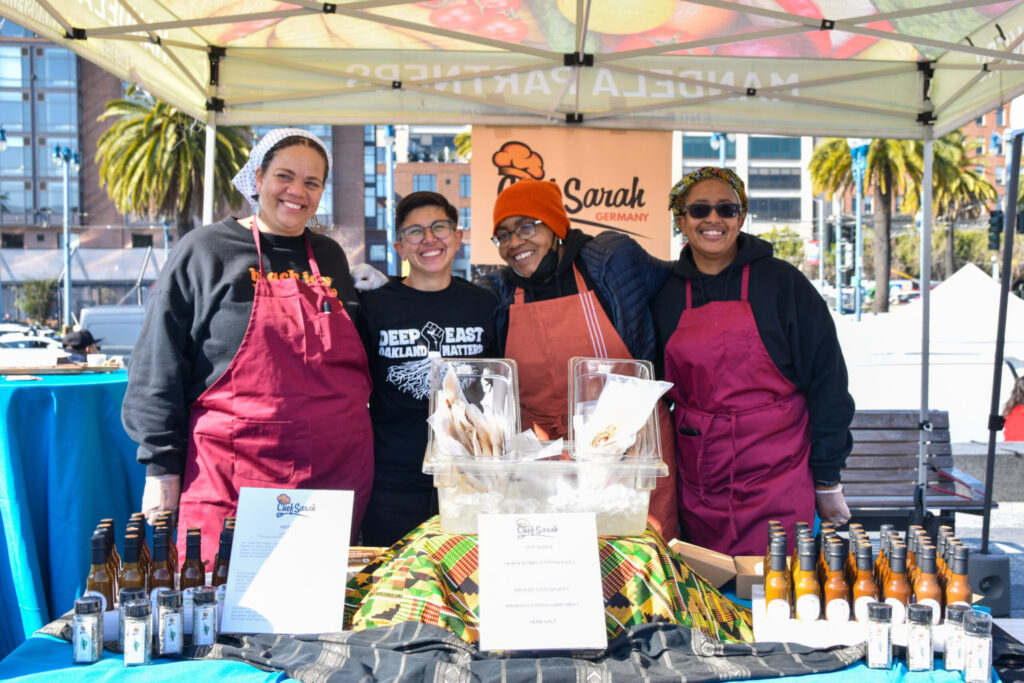
From the first day of joining Foodwise’s Building Equity program, there’s an orientation. That’s where we first met Deven, who was so clear about everything—what to expect, what you would see, where you would see it—so that we felt very prepared for the day. Getting there that morning at 6:30 am, like insanely early, and then having that whole line greet you, it was like, “We got a team, they’re going to take care of us.” It felt really great.
We didn’t have our own tent, we didn’t have tables or tablecloths, and we had no idea how this worked. They had it when we got there. There was a tent labeled and ready for us. Even now, Deven will walk through the farmers market at least twice a Saturday just to check on us. “Chef, you good? You need anything? How y’all doing?” “We good, thank you.” So that always feels amazing. It’s just folks who come through and make us feel seen.
One of the things about being a small business in the startup phase is that you don’t feel seen a lot. It’s like you’re always struggling to get your product out there, struggling to meet the numbers. We’ve been running this project based on faith and sweat.
I applied for three small business loans, but I was turned down because we don’t have a “financial history.” We haven’t been in business long enough. We’re not coming in with homes to leverage. We don’t have those networks or resources. Financial institutions are not looking at us as viable businesses to invest in. The Building Equity program is providing that opportunity.
Our business is a business now because of where we’re standing every Saturday. That’s the thing that’s so crazy—we literally stand in this 10-by-10 square, and that has gotten us into five stores in San Francisco because someone tasted our hot sauce at the stand.
Foodwise has been the foundation that has moved Chef Sarah Germany from a concept to a functional business. Being one of the vendors in the Ferry Plaza Farmers Market feels like I got to finally be on the varsity team. It’s provided us a platform to actually figure out who we are as a business, and more importantly, who we can be.
Help Early-Stage BIPOC Food Entrepreneurs Thrive
Foodwise needs your support to subsidize permit costs and stall fees for members of our Building Equity program, allowing them the opportunity to establish their businesses and become permanent fixtures in our Bay Area food community. Donate today to support BIPOC entrepreneurs in 2026 and beyond.
Topics: Building Equity program, Chef, Entrepreneurship